

For over nine decades, the Raymond name has been synonymous with quality suiting. But in a modern market flooded with direct-to-consumer startups and Italian luxury houses, where does this heritage Indian brand stand? Is a Raymond suit a smart sartorial investment, or are you paying for legacy alone?
This review cuts through the marketing to analyze Raymond’s core offerings—from ready-to-wear to its famed Made-to-Measure service. We’ll examine fabric, construction, value, and who the brand truly serves, helping you decide if it deserves a place in your wardrobe.
Part 1: Brand Legacy vs. Modern Reality
Raymond isn’t just a clothing company; it’s a vertically integrated textile giant. This is its foundational advantage: it controls the process from wool sourcing to finishing fabric in its own mills. For the consumer, this translates to exceptional control over material quality at a potentially better value than brands that source externally.
However, the “heritage” tag can be ambiguous. In India, Raymond is a premier, aspirational brand for business and wedding suiting. Globally, particularly in Western markets, its presence is more niche, often found in multi-brand stores or through its dedicated Made-to-Measure service. The key takeaway: You are buying into proven textile expertise and manufacturing scale, not just a fashion label.
Part 2: Suit Quality Breakdown: Fabric, Construction & Finish
Let’s evaluate what you’re actually getting, separating objective quality from subjective style.
1. Fabric & Materials (Raymond’s Core Strength)
This is where Raymond consistently excels. Their “Realms” range of fabrics (e.g., Super 100s to Super 200s wool, blends) offers strong, durable weaves with a good hand-feel. Their worsteds are particularly praised for holding a crease and resisting wrinkles.
-
Verdict: For the price point, Raymond fabrics often outperform similarly priced European off-the-rack suits. You get high-quality material fundamentals.
2. Construction: Fused vs. Half-Canvas
This is a critical differentiator. Understanding construction is key to assessing value and longevity.
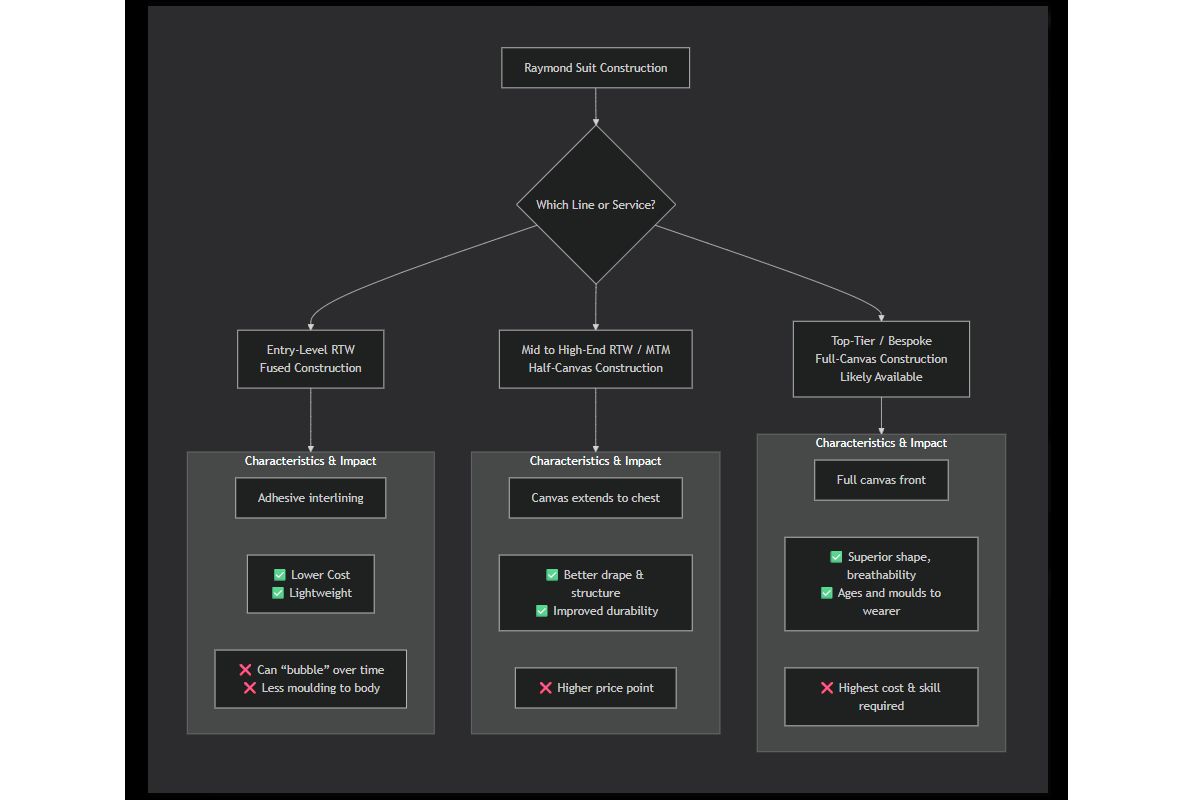
Key Insight: Many of Raymond’s better ready-to-wear and most Made-to-Measure suits utilize half-canvas construction, which provides a good balance of shape, breathability, and value. Always ask about construction—it’s a more important question than thread count.
3. Fit, Finish & Design
-
Fit: The house cut for ready-to-wear is typically conservative and structured—ideal for traditional business environments. It’s not as soft or fashion-forward as a Neapolitan cut. The MTM service exists to perfect this fit for your body.
-
Finish: Stitching is generally precise and consistent. Buttons are functional, and details like pick-stitching are clean, if not always executed with the flair of a high-end Italian workshop.
-
Design: Style is classic, not trendy. You buy a Raymond suit for enduring elegance, not runway statements. Lapels, pockets, and silhouettes adhere to timeless conventions.
Part 3: The Made-to-Measure (MTM) Service: Deep Dive Analysis
The existing article provides a good process overview. Let’s add the crucial analytical layer to answer “Is it worth it?”
-
The Value Proposition: Raymond MTM is not bespoke. It’s a pattern-adjusted customization system. You get a vastly superior fit over RTW and personalization (fabric, lining, buttons), but within a set template. The value isn’t in unlimited creativity, but in achieving a flawless, personal fit with premium materials.
-
The Fabric Markup: While you select from excellent fabrics, expect a retail markup on the cloth itself. The true cost includes the cutting, making, and fitting service.
-
Ideal Candidate: The Raymond MTM client is someone who has outgrown standard sizing, has a proportions (e.g., athletic build, longer torso) or is investing in a cornerstone garment (wedding suit, key business suit) and prioritizes guaranteed fit and hassle-free process over an artistic collaboration with a tailor.
Part 4: Competitive Analysis: Where Raymond Stands
To judge “worth,” we must compare. Here’s how Raymond positions itself in the market landscape.
| Competitor Type | Example Brands | Typical Price Point (Suit) | Raymond’s Advantage | Raymond’s Disadvantage |
|---|---|---|---|---|
| Mass-Market RTW | Jos. A. Bank, Men’s Wearhouse | $200 – $600 | Far superior fabric quality, better half-canvas construction options, more durable. | Higher price. More formal/style options. |
| Online DTC Brands | Indochino, Suitsupply | $400 – $900 | Heritage textile control, potentially more consistent manufacturing quality, in-person MTM service. | Less digitally-native, may have less trendy styling. |
| European Luxury RTW | Hugo Boss, Canali | $1,000 – $3,000+ | Better value for materials, strong MTM value proposition against entry-level luxury. | Less prestigious brand cachet in Western markets, often more conservative styling. |
| Local Bespoke Tailors | Independent artisans | $1,500 – $5,000+ | Standardized process, reliability, faster turnaround, brand-backed guarantees. | Less artistic freedom, truly one-of-a-kind garment, or hyper-local personalized service. |
Part 5: Final Verdict & Who Should Buy Raymond
Is Raymond a good brand? Yes, unequivocally for what it is. It is a premier brand for high-quality, traditional suiting with a legitimate heritage in textiles. It is not a fashion-forward luxury label, but a producer of enduring, quality garments.
Who should buy a Raymond suit?
-
✅ The Value-Conscious Connoisseur: You understand fabric and construction and want the best materials for your money.
-
✅ The Traditional Professional: You need reliable, elegant suiting for a corporate environment.
-
✅ The First-Time MTM Buyer: You want to step into custom tailoring via a trusted, low-risk system with a guaranteed fit.
-
✅ The Wedding Party Planner: Needing multiple consistent suits with a reliable turnaround.
Who should look elsewhere?
-
❌ The Trend-Driven Dresser: You seek sharp lapels, ultra-soft shoulders, and current silhouettes.
-
❌ The Bespoke Purist: You want a completely blank slate and a collaborative artist-tailor relationship.
-
❌ The Ultra-Budget Shopper: You need a basic suit under $300 for infrequent use.
The Bottom Line: A Raymond suit, particularly from its MTM service, is a rational and excellent investment in foundational wardrobe armor. You pay for tangible quality—superb fabrics and solid construction—backed by decades of expertise. You invest in timelessness, not transience. For that purpose, it delivers outstanding value and is highly recommended.