

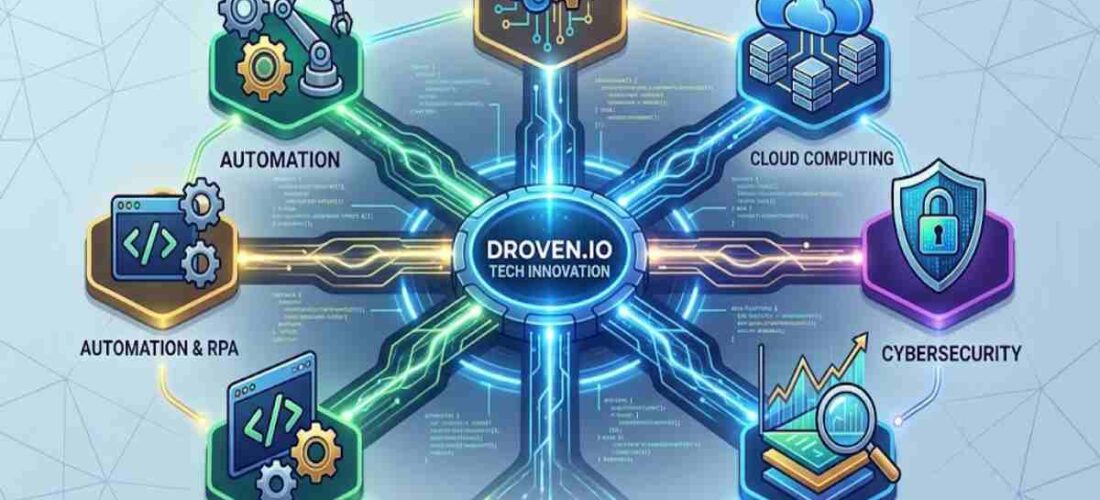
Enterprise technology is moving from a support function to a core driver of business strategy. Artificial intelligence, cloud computing, automation, cybersecurity, data platforms, and software engineering are increasingly connected rather than operating as separate IT projects.
That shift is central to the search interest around droven.io enterprise tech innovation. Droven.io presents technology topics spanning artificial intelligence, information technology, cloud computing, cybersecurity, software development, digital transformation, AI business processes, and big-data analytics.
But there is an important distinction for readers: Droven.io should primarily be understood as an informational technology platform, not automatically as an enterprise software vendor or IT consultancy. Its published material focuses on explaining technology developments and business applications rather than establishing that it sells a specific enterprise technology stack.
Key Takeaways
| Topic | What matters most |
|---|---|
| Enterprise innovation | Technology should solve measurable business problems |
| AI | Useful when integrated into workflows, data and governance |
| Automation | Best suited to repeatable, rules-driven processes |
| Cloud | Provides scalability, flexibility and integration capabilities |
| Data | High-quality enterprise data is a prerequisite for useful AI |
| Cybersecurity | Innovation must be accompanied by security controls |
| Governance | AI adoption needs accountability, monitoring and human oversight |
| Droven.io | Primarily useful as an educational technology resource |
What Does Enterprise Tech Innovation Mean?
Enterprise tech innovation refers to the adoption or development of technologies that materially improve how a large organization operates, serves customers, manages information, develops products or makes decisions.
It is broader than simply purchasing new software.
A company can implement an expensive AI platform and still have an outdated operating model. Conversely, a relatively simple automation can create substantial value if it eliminates a bottleneck that affects thousands of transactions.
Modern enterprise innovation typically combines several technology layers:
- Artificial intelligence and machine learning
- Generative and agentic AI
- Robotic Process Automation (RPA)
- Cloud computing
- Data platforms and analytics
- Cybersecurity
- APIs and systems integration
- DevOps and software engineering
- Digital customer experiences
- Enterprise workflow automation
This is why droven.io enterprise tech innovation is better understood as a broader technology topic than as a single product or software solution.
How Droven.io Covers Enterprise Technology
The official Droven.io information-technology category currently covers areas including cloud computing, cybersecurity, IT infrastructure and DevOps. Its broader navigation also includes AI, generative AI, AI automation work, AI in business and marketing, digital transformation, AI business processes and big-data analytics.
That coverage matters because enterprise innovation rarely happens through one technology.
For example, an organization deploying an AI customer-service assistant may need:
- A language model
- Secure access to business data
- An integration layer
- Identity and access management
- Monitoring
- Human escalation
- Compliance controls
- Performance measurement
The AI model is only one component.
This is an important correction to the common perception that enterprise innovation means simply “adding AI.”
Why Enterprise AI Is Growing
The business case for AI is becoming stronger, but adoption is still considerably more complicated than technology marketing sometimes suggests.
An IBM Institute for Business Value study of 2,000 CEOs across 33 countries found that 61% of surveyed CEOs were actively adopting AI agents and preparing to implement them at scale. However, only 16% of AI initiatives had scaled enterprise-wide, while respondents also reported disconnected technology as a major challenge.
That gap between experimentation and scale is one of the most important issues in enterprise innovation.
The Enterprise AI Adoption Gap
| Stage | Typical situation | Main challenge |
|---|---|---|
| Experimentation | Teams test AI tools | Selecting valuable use cases |
| Pilot | One workflow is automated | Proving business value |
| Production | AI enters daily operations | Reliability and integration |
| Scale | Multiple departments adopt AI | Governance and architecture |
| Transformation | AI changes operating models | Organizational redesign |
The lesson is straightforward: AI experimentation is relatively easy; sustainable enterprise adoption is difficult.
The Role of AI in Enterprise Innovation
AI can influence an organization in several different ways.
1. Employee Productivity
AI assistants can help employees summarize documents, draft communications, analyze information, generate code and retrieve internal knowledge.
2. Customer Operations
AI can support customer-service representatives, classify requests, recommend responses and identify recurring problems.
3. Decision Support
Machine-learning systems can identify patterns in large datasets that would be difficult to detect manually.
4. Software Development
AI-assisted development can accelerate coding, documentation, testing and debugging.
5. Business Process Automation
AI can be combined with conventional automation to handle workflows involving documents, classification and decision support.
The important distinction is that AI should augment a business process before an organization attempts to fully automate it.
RPA and Enterprise Automation
Robotic Process Automation remains relevant because not every business problem requires sophisticated generative AI.
RPA is particularly useful for repetitive, structured activities such as:
- Moving information between applications
- Processing standardized documents
- Updating spreadsheets
- Generating routine reports
- Performing repetitive data-entry tasks
- Triggering predefined workflows
A strong enterprise automation strategy often combines traditional automation with AI.
For example:
Document received → AI extracts information → rules validate information → RPA updates system → human reviews exceptions.
This hybrid approach can be more practical than trying to give an AI agent complete control.
Cloud Computing as the Foundation
Enterprise innovation also depends heavily on cloud infrastructure.
Cloud environments can provide:
- Elastic computing capacity
- Centralized data services
- Application integration
- Managed databases
- AI infrastructure
- Disaster recovery capabilities
- Development and deployment environments
Droven.io’s information-technology coverage explicitly includes cloud computing and its site navigation identifies a dedicated cloud-computing section covering major cloud platforms.
However, cloud migration should not automatically be considered innovation.
Moving an inefficient application from an on-premises server to the cloud can simply create an inefficient cloud application.
The better question is:
What business capability becomes possible after modernization?
Data Is the Hidden Layer of Innovation
AI systems depend on data.
If enterprise information is fragmented across spreadsheets, legacy applications, departmental databases and disconnected cloud services, an AI initiative can struggle even when the underlying model is powerful.
IBM’s 2025 CEO research found that 68% of surveyed CEOs considered integrated enterprise-wide data architecture critical for cross-functional collaboration, while 72% viewed proprietary organizational data as important to unlocking generative AI value.
This creates a practical hierarchy:
Data quality → Integration → Governance → AI → Business value
Not the other way around.
Cybersecurity Cannot Be an Afterthought
Greater connectivity also creates a larger attack surface.
Enterprise AI introduces additional considerations around:
- Sensitive data exposure
- Identity management
- Access permissions
- Model security
- Prompt injection
- Third-party integrations
- Data leakage
- Auditability
- Compliance
Droven.io currently publishes information-technology content that includes cybersecurity and data privacy alongside cloud computing and technology topics.
For enterprises, security should therefore be incorporated at the architecture stage rather than added after deployment.
Enterprise Innovation Needs Governance
The fastest technology is not necessarily the best enterprise technology.
Governance determines:
- Who can use an AI system
- Which data it can access
- Which decisions require human approval
- How outputs are monitored
- How incidents are reported
- How models are evaluated
- When a system should be retired
Research into enterprise generative-AI adoption has similarly identified technology complexity, governance gaps, resource alignment, and data maturity as major barriers to scaling.
This is why responsible innovation often looks slower at the beginning but can move faster once systems reach production.
A Better Framework for Enterprise Technology Decisions
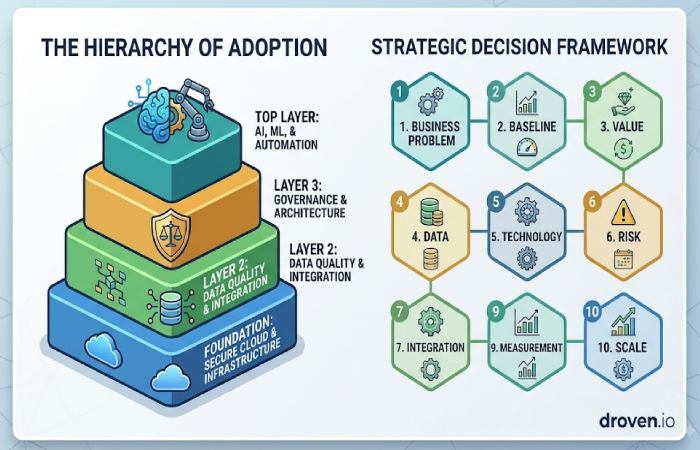
Companies evaluating a new technology should avoid starting with the question:
“What AI tool should we buy?”
Instead, use this sequence.
| Step | Question |
|---|---|
| 1. Business problem | What problem are we solving? |
| 2. Baseline | How does the process work today? |
| 3. Value | What measurable improvement is possible? |
| 4. Data | Do we have the required information? |
| 5. Technology | Which technology is appropriate? |
| 6. Risk | What could go wrong? |
| 7. Integration | How will it connect to existing systems? |
| 8. Adoption | Will employees actually use it? |
| 9. Measurement | Which KPIs determine success? |
| 10. Scale | Can the solution work across departments? |
This approach prevents technology from becoming the strategy.
What Businesses Can Learn From Droven.io’s Technology Coverage
One useful characteristic of Droven.io’s technology coverage is its breadth.
The site connects AI with business, automation, digital transformation, cloud computing, cybersecurity, software development and analytics rather than treating each topic as completely isolated.
For beginners, this creates a useful learning path:
AI basics → automation → cloud → data → cybersecurity → digital transformation → enterprise application
For professionals, the more interesting question is how these technologies interact.
For example, an AI application might require cloud infrastructure, enterprise data, API integration, cybersecurity controls and software engineering practices simultaneously.
That interconnectedness is where genuine enterprise innovation occurs.
Where the Keyword Can Be Misleading
Search phrases surrounding enterprise technology can sometimes make an informational platform appear to be an enterprise technology provider.
Based on publicly available information reviewed for this article, Droven.io is better characterized as a technology information and education platform. One source explicitly distinguishes it from IT service providers and software vendors.
That distinction is important for users researching:
- Enterprise software
- IT consulting
- AI implementation
- Automation services
- Technology vendors
- Remote IT jobs
Readers should verify whether a website actually provides these services before submitting business information, applying for a job or purchasing a technology product.
Droven.io Enterprise Tech Innovation: Who Should Use the Information?
The topic can be useful for several audiences.
Beginners
Beginners can use technology explainers to understand terminology before evaluating vendors or tools.
Business Owners
Small and mid-sized businesses can identify areas where automation or cloud technology may remove operational bottlenecks.
IT Professionals
Technical readers can use broad technology coverage as a starting point before moving to vendor documentation and technical research.
Executives
Executives should focus less on individual tools and more on business outcomes, governance, data architecture and measurable ROI.
The Biggest Mistake Enterprises Make
The biggest mistake is treating technology adoption as the destination.
Buying an AI platform does not create innovation.
Deploying an RPA bot does not automatically create transformation.
Migrating to the cloud does not automatically modernize a company.
Innovation occurs when technology changes the economics, speed, quality or capabilities of a business.
McKinsey’s analysis of enterprise technology makes a similar point: enterprise technology spending has increased substantially, while productivity gains have not necessarily kept pace. Its research argues for treating technology investment as a value-creation problem rather than simply an IT-spending problem.
How to Measure Enterprise Tech Innovation
Executives should establish measurable KPIs before deployment.
Useful metrics include:
- Processing time
- Cost per transaction
- Revenue per employee
- Customer response time
- Error rate
- Employee productivity
- System availability
- Security incidents
- Automation rate
- Customer satisfaction
- AI inference cost
- Time to market
For example, an AI project that reduces employee workload by 30% sounds promising.
But if employees spend the saved time correcting AI errors, the real productivity improvement may be close to zero.
That is why measurement must cover the entire workflow, not just the technology’s headline performance.
The Future of Enterprise Tech Innovation
The next phase of enterprise technology is likely to involve greater integration between AI agents, automation platforms, cloud infrastructure and business applications.
The direction is already visible: IBM reported that surveyed CEOs expected AI investment growth to more than double over the following two years, while McKinsey has argued that organizations can potentially extract substantially more value from enterprise technology by combining AI adoption with changes to the technology function itself.
But the future will not simply belong to companies with the most AI.
It will belong to organizations that can combine:
AI + trusted data + automation + secure infrastructure + capable employees + governance + measurable business outcomes.
That is the more useful interpretation of droven.io enterprise tech innovation.
Conclusion
Enterprise technology innovation is no longer about collecting the newest tools. It is about redesigning how an organization creates value. Droven.io’s technology coverage provides a useful entry point for understanding the interconnected subjects behind this transformation, including AI, automation, cloud computing, cybersecurity, software development, and digital transformation.
The strongest enterprise strategy is therefore not “AI first.” It is “business problem first, technology second.” That mindset turns droven.io enterprise tech innovation from a search phrase into a much more useful framework for evaluating how emerging technology can genuinely improve modern organizations.