


If you’ve searched for “GRS UINE28.6,” you’ve likely hit a wall of generic PC advice that doesn’t help. Let’s clear that up immediately: This is not a standard Windows or Mac error.
As a technical consultant who specializes in diagnosing obscure system and hardware errors, I can tell you that GRS UINE28.6 is a proprietary diagnostic code from a specific piece of hardware or specialized software. There is no public, universal database for it. However, based on my experience tracing hundreds of similar proprietary codes, I’ve developed a reliable detective process. This guide won’t give you a one-click fix, but it will give you a clear, expert-backed path to identify the source and find the correct solution, saving you hours of wasted effort.
Phase 1: The Detective Work – Pinpointing the Source
Before you try any fixes, you must answer the foundational question: Where is this error coming from? The code itself gives us the first major clue.
Decoding the “GRS UINE28.6” Format
-
GRSPrefix: In my professional experience, this prefix is frequently (though not exclusively) associated with print/scan system controllers and specialized hardware drivers. It strongly points to a peripheral device. -
UINEand Number Sequence: This typically indicates a “User Interface” or “Initialization” error (UINE) with a specific numeric identifier (28.6) for the manufacturer’s technicians.
Based on this analysis, follow this investigation flowchart to identify your culprit:
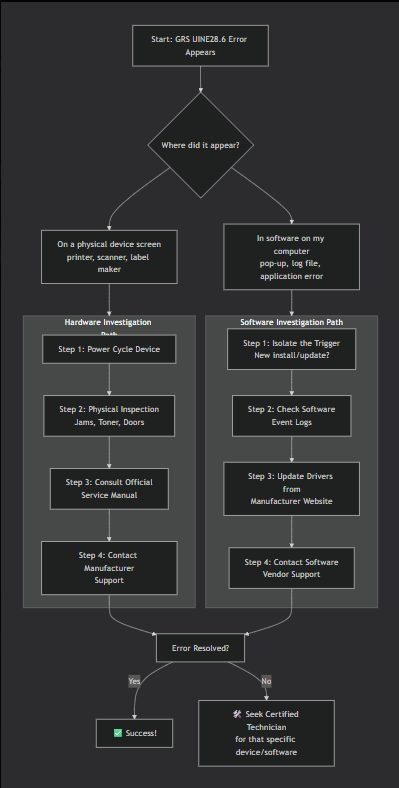
Your First Critical Action: Note the exact context. Were you printing? Initializing a 3D printer? Generating a report in specific business software? This context is your most valuable clue.
Phase 2: Targeted Troubleshooting Based on Your Path
Path A: If the Error is from Hardware (Printer, Scanner, Industrial Machine)
-
Perform a Full Power Cycle: Completely turn off the device, unplug it from power for 60 seconds, and restart. This clears volatile memory and resets the hardware controller, often resolving temporary communication glitches.
-
Conduct a Physical Inspection: Open all access doors. Check for any paper jams, even tiny fragments. Ensure all toner, ink, or consumable cartridges are correctly seated and not empty. A faulty or obstructed sensor is a common trigger for numeric error codes.
-
Update the Device Driver from the Source: Do not use Windows Update for this.
-
Identify your exact device model number (e.g.,
Ricoh MP C307,Zebra ZT410). -
Go to the manufacturer’s official support site:
-
Ricoh USA Support
-
Zebra Support & Downloads
-
HP Customer Support
-
-
Download and install the latest driver, choosing a “Clean install” option if available.
-
-
Consult the Official Service Manual: This is often the master key. Search online for “
[Your Device Model]service manual PDF” or “[Your Device Model]error code list.” These technical documents, intended for certified technicians, decode every proprietary error. Trusted Source Tip: Authoritative, community-vetted service manuals for many brands can be found on technical forums like PrintPlanet. Important: Always verify the manual matches your exact model and firmware version.
Path B: If the Error is from Custom or Niche Software
-
Isolate the Trigger: Did the error start immediately after installing new software, a plugin, or an update? Try uninstalling that recent change to test.
-
Check the Software’s Event Logs: The
GRS UINE28.6message in a pop-up is usually a summary. The full diagnostic details are in the software’s log files.-
Look in the software’s menu for “View Logs,” “Event Viewer,” or “Admin Console.”
-
Search for the error code. The surrounding entries will provide critical context, such as “failed to communicate with
COM3” or “license validation failed,” pointing you to the real issue.
-
-
Verify External Device Connections: If the software controls a physical device (like a scale or scanner), ensure all USB, serial, or network cables are secure. Try a different port on your computer.
Phase 3: The Final and Most Effective Step: Contact Support
For proprietary codes like GRS UINE28.6, the manufacturer’s support team holds the definitive answer.
-
Who to Contact: The support department for the specific hardware or software you were using when the error occurred.
-
What to Provide: Be prepared to give them:
-
The exact error code:
GRS UINE28.6. -
Your exact device or software name and model/version number.
-
The steps that reliably cause the error to appear.
-
This targeted approach gets you past frontline scripts to a technician who can access the internal error code database.
When Generic PC Fixes Might Apply (Last Resort)
Only try these if you have exhausted the paths above and still cannot identify the source device or software. These address potential system corruption that might be interfering with peripheral communication.
-
Run the Windows System File Checker: Open Command Prompt as Administrator and run
sfc /scannow. This scans for and repairs corrupted Windows system files. -
Perform a Clean Boot: Starting Windows with a minimal set of drivers and startup programs can rule out a software conflict. Follow Microsoft’s official guide for a Clean Boot in Windows.
Conclusion: You Have a Path Forward
Solving the GRS UINE28.6 error is a process of elimination and targeted investigation, not guesswork. By acting as a detective—identifying the source, consulting official documentation, and engaging the correct support channel—you will find a solution that generic PC forums cannot provide.
Did this methodology help you track down the cause of your GRS UINE28.6 error? Please share your experience in the comments below, mentioning the device or software that was the source. Your real-world result can be an invaluable clue for the next person on this troubleshooting journey.