

There’s a widespread assumption that the right person to make technology decisions is the person who understands the technology best. It seems logical. In practice, it produces a specific and predictable failure: technically sound decisions that don’t serve the business.
The most technically capable IT team in the world, given the task of building a technology environment, will build an excellent technology environment — optimized for technical coherence, architectural elegance, and operational manageability. What it won’t necessarily be is an environment that serves the business’s strategic goals, supports its competitive position, or produces a return that justifies the investment. That requires something different: strategic oversight applied to technology decisions.
This is the gap that strategic IT leadership is designed to fill.
This article belongs to Technology
The Difference Between Technical Expertise and Strategic Judgment
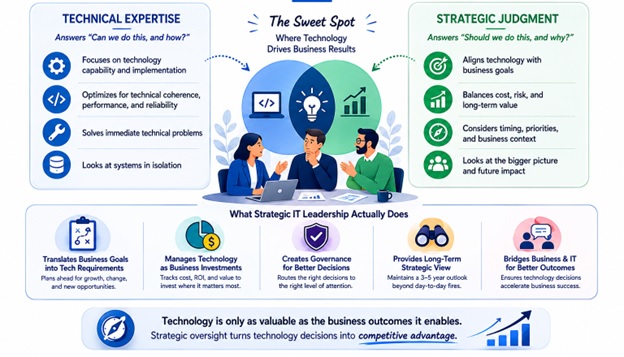
Technical expertise answers the question “can we do this, and how?” Strategic judgment answers the question “should we do this, and why?” Both questions matter. Only one of them connects technology to business outcomes.
A technically excellent recommendation for upgrading a data warehousing platform might be entirely correct on its merits — the new platform is faster, more reliable, better supported, and architecturally cleaner. But if the business is six months from a major ERP migration that will change the data architecture significantly, the timing is wrong. If the expected ROI from improved analytics capability requires a data science function the business doesn’t have and isn’t planning to build, the investment assumption is flawed. These are strategic considerations that require business context to evaluate.
Technical experts operating without strategic oversight make decisions that optimize the technology without optimizing for the business. The decisions aren’t wrong — they’re just incomplete.
What Strategic IT Leadership Actually Does
Strategic IT leadership operates at the intersection of technology capability and business direction. In practice, this means a few specific things.
It translates business objectives into technology requirements. When the business decides to expand into a new geography, or enter a new market segment, or acquire a competitor, the technology implications of those decisions need to be understood and planned for — ideally before the decision is executed, not after. Strategic IT leadership creates that translation function.
It manages the technology portfolio as a set of business investments. Every technology system has a cost and is supposed to produce some return — in operational efficiency, in capability, in risk reduction, in revenue enablement. Strategic IT leadership tracks this portfolio, identifies where return is being produced and where it isn’t, and makes recommendations about where to invest more and where to divest.
It creates governance for technology decisions. Not every technology decision needs executive involvement. But some do — specifically, the ones that establish architectural direction, create significant cost commitments, or have material implications for security or regulatory compliance. Strategic oversight creates a governance structure that routes the right decisions to the right level of attention.
And it provides the long-term view that operational management can’t easily maintain. The team managing day-to-day technology operations has a short time horizon by necessity — the problems in front of them are real and urgent. Strategic IT leadership maintains the three-to-five-year view: what does the technology environment need to look like, and how do current decisions contribute to or detract from that target?
The Role of IT Strategy Consulting
Many organizations don’t have the internal capacity for strategic IT leadership — either because the function hasn’t been built or because existing IT resources are fully consumed by operational management.
Engaging professional it strategy consulting is how organizations access this capability without the overhead of building it from scratch internally. The value comes from the combination of strategic methodology, cross-industry pattern recognition, and business-technology translation expertise that effective consulting brings.
Critically, the engagement model matters. Strategy consulting that produces a plan and then disengages leaves the organization without the ongoing governance function that makes the strategy useful. The more valuable model creates the framework, builds the internal capability to maintain it, and provides ongoing advisory support as the business evolves.
When Technical Expertise Needs Strategic Support
The scenarios where technical expertise most needs strategic support are often not obvious until they’ve already become problems.
Platform selections are a common one. Choosing a core business platform — ERP, CRM, cloud infrastructure, data platform — involves technical evaluation criteria and also significant strategic considerations: vendor stability, integration ecosystem, total cost of ownership over a realistic horizon, flexibility to accommodate future business changes, and fit with the organization’s capability to manage and evolve the platform over time. Technical experts can evaluate the technical criteria rigorously. The strategic criteria require business context and judgment that may not be available internally.
Security investments are another. Security needs resources, and those resources have to come from somewhere. Allocating them requires making judgments about risk — which threats are most likely, which would be most damaging, where current controls are adequate and where they’re insufficient. These are risk management judgments that require both technical understanding and business context.
Major IT initiatives — migrations, consolidations, large-scale implementations — require both technical execution capability and strategic oversight to deliver the business value they were designed to produce. The technical team delivers the project. Strategic oversight ensures the project is delivering against business objectives, not just technical specifications.
The organizations that navigate technology successfully tend to have solved a coordination problem: how do the people who understand the technology and the people who understand the business make decisions together? The answer, consistently, is some form of strategic IT oversight that creates that coordination.
Without it, the two domains operate separately, and the gap between what the technology does and what the business needs tends to widen over time. With it, technology becomes what it should be: a managed asset that serves business strategy and compounds advantage over time.