

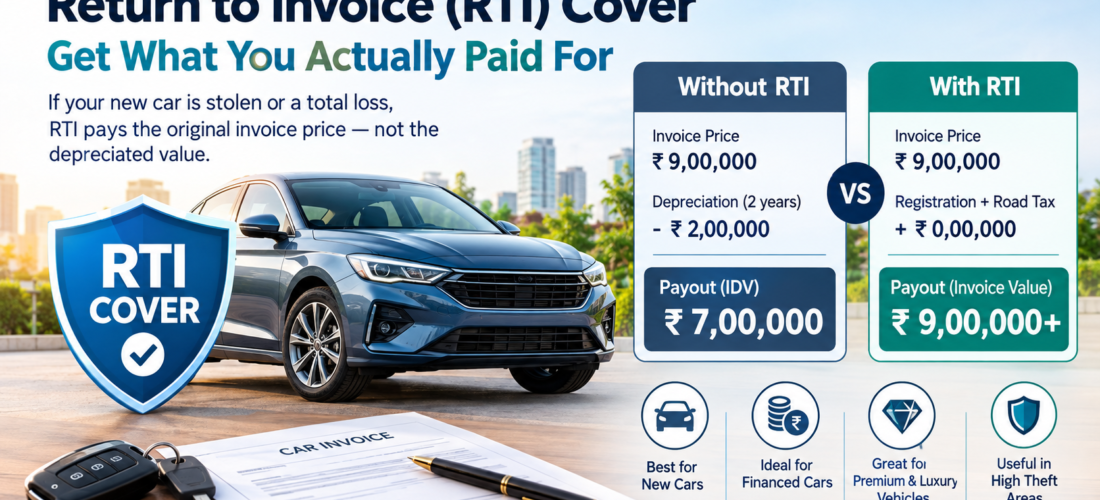
Say your brand-new car gets stolen tonight. Just gone, vanished from outside your building, no trace. Your insurer steps in, sure, but here’s the catch. They will never give you what you have paid for. You’ll get its current value instead, already reduced by depreciation, even though the car is barely a few months old.
That gap between what you paid and what you’ll receive? That’s exactly the problem return to invoice cover was built to solve.
What Exactly Is RTI Cover?
Return to invoice, RTI for short, is an add-on you attach to your comprehensive policy. Here’s what it actually does. Total loss? Stolen and gone? RTI pays you the original invoice price. Not the depreciated number your insurer would normally hand over.
Here’s the part most people miss. Most standard car insurance online plans settle total-loss claims using the Insured Declared Value. And that value starts dropping the second you drive out of the showroom. RTI skips all of that. It pays what you actually spent- invoice price plus registration plus road tax.
Why the Difference Actually Matters
Let’s actually run the numbers. Nine lakh rupees, that’s what you paid for the car. Two years pass. Then it gets stolen. Your insurer works out the IDV, subtracts two years’ worth of depreciation, and offers you around seven lakhs. Do the maths. That’s a two-lakh rupee hole in your pocket, for a car that’s simply gone.
With RTI attached, that same claim pays out the full nine lakh, sometimes more once registration and road tax get added in. No depreciation math working against you. No unpleasant surprise the day you actually need the money.
When It’s Genuinely Worth Adding
RTI isn’t something every car owner needs. But for certain situations, it earns its cost many times over.
- Brand new cars, especially in their first one to three years, when depreciation hits hardest.
- Cars bought on loan, where the payout needs to actually cover what you still owe the bank.
- Premium or luxury vehicles, where the invoice-to-IDV gap tends to be larger in absolute terms.
- Areas with higher theft rates, where the odds of needing this cover aren’t purely theoretical.
If your car falls into even one of these categories, the math usually favours adding RTI. It’s a small yearly cost against a genuinely large potential shortfall.
When You Can Probably Skip It
Older cars don’t benefit much here. Most insurers stop offering RTI once a vehicle crosses three to five years old, since the invoice-to-market gap has usually narrowed by then anyway. If you’re driving something well past that age, or a car you bought used, RTI likely isn’t available to you, and honestly, it wouldn’t add much value even if it were.
One more thing to keep in mind. RTI only activates for total loss or theft. A dented door? A cracked headlight? Doesn’t trigger it, not even close. Minor repairs, however costly, simply sit outside what this cover does.
What It Actually Costs
Roughly ten percent more, on top of your comprehensive premium. That’s the ballpark for RTI. For a mid-range car, we’re talking a few thousand rupees extra each year. Now weigh that against a two or three lakh rupee gap. For anyone driving something newer or pricier, that trade just makes sense.
How It’s Different From Other Add-Ons
People often confuse RTI with zero depreciation cover, but they solve different problems entirely. Zero depreciation applies to regular repair claims, making sure your insurer doesn’t deduct for worn parts during a routine fix. RTI only activates for total loss or theft, and it pays out the invoice value rather than just skipping depreciation on a repair bill.
Some insurers also bundle RTI-style benefits within broader personal protection plans like accident prime cover, which combines multiple add-ons under one policy. Worth comparing the bundled cost against buying RTI separately, since bundled plans sometimes work out cheaper depending on what else you actually need.
A Quick Example to Make This Real
Picture someone financing a new hatchback for eleven lakh rupees. Eighteen months in, a fire in the parking garage totals the car completely. Without RTI, the insurer calculates depreciation for those eighteen months and offers something closer to nine lakhs. That leaves a two-lakh rupee gap between what the bank is still owed and what the payout actually covers, a gap that comes straight out of pocket.
With RTI attached, the same claim pays out closer to the full eleven lakhs, invoice price included. The loan gets cleared, no shortfall, no scrambling for extra funds right after losing a car. This is exactly the scenario where pairing RTI with something like accident prime cover makes sense, since financed vehicles carry this exact risk more than any other category.
Filing a Claim Under RTI
The process mirrors a regular total-loss claim, with a few extra steps. Filing an FIR should be your immediate action if your car has been stolen. That is a must-do thing. Submit your original invoice copy alongside your claim, since that’s literally what determines your payout amount. Keep your registration and road tax receipts handy too, since RTI typically reimburses those costs along with the base invoice value.
Processing usually takes a few weeks once documentation is complete, similar to any other total-loss settlement. The main difference shows up in the final number, not the paperwork trail leading up to it.
Making the Decision
Before your next renewal, take a moment to actually calculate the gap. Check your car’s current IDV against what you originally paid. If that difference feels uncomfortably large, and your car still qualifies by age, adding RTI through your car insurance online renewal is a straightforward decision. A few thousand rupees now protects you from a much bigger loss later, precisely when you’d need that protection most.
Insurance, at its core, is about closing gaps you can’t afford to fill yourself. For a new car, the depreciation gap is exactly that kind of risk. RTI exists specifically to close it.